


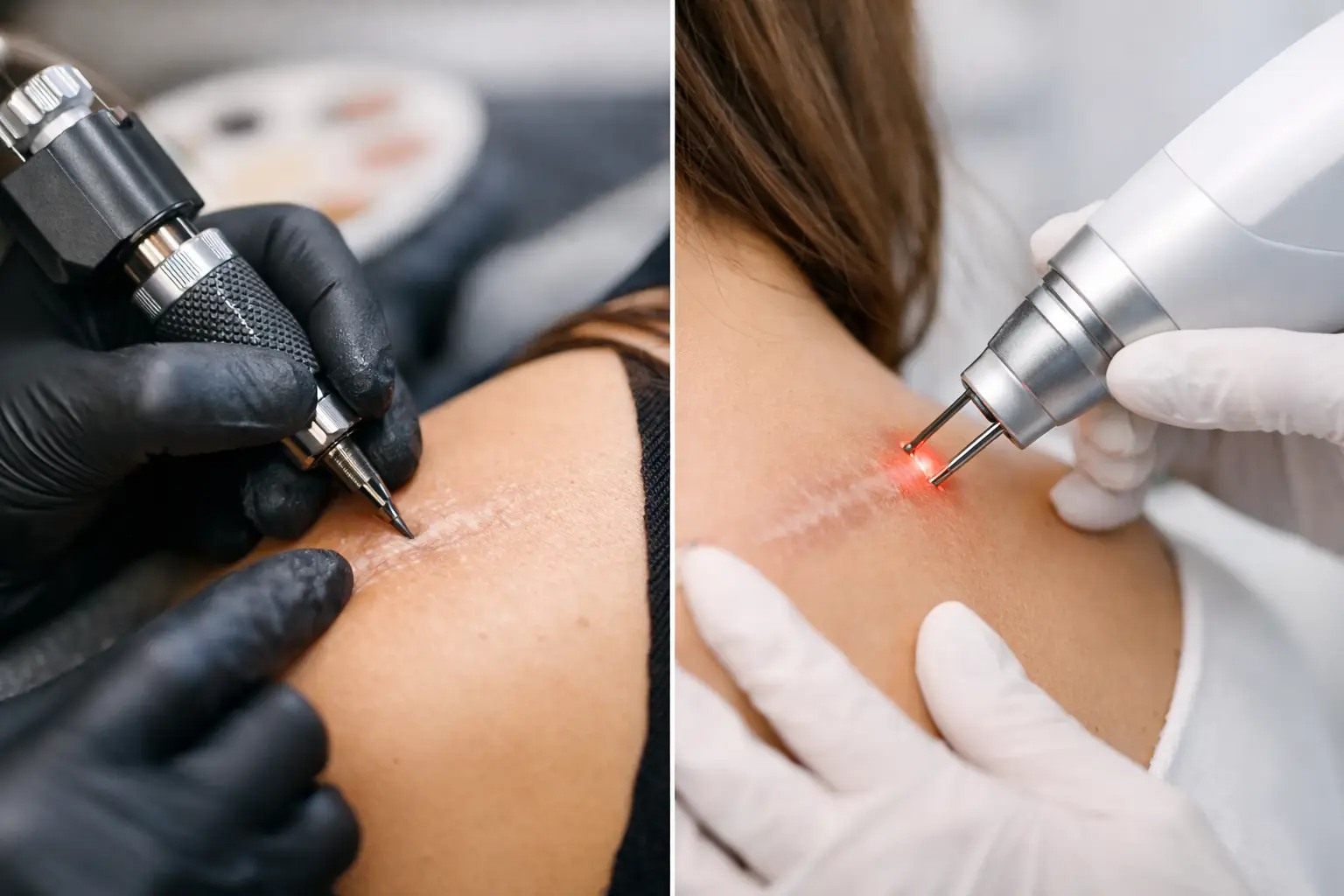
A scar can be physically healed yet still draw attention every time you get dressed, look in the mirror or plan a holiday. When comparing scar tattooing vs laser, the right choice is rarely about which treatment is “better”. It is about what the scar needs: a change in colour, texture, thickness, visibility, or a combination of these.
Laser treatments and paramedical scar camouflage work in very different ways. One may help improve the skin’s surface or reduce redness; the other uses specialist pigment work to blend a settled scar more closely with the surrounding skin. Knowing the distinction protects you from investing in a treatment that cannot realistically solve your main concern.
Scar Tattooing vs Laser: The Core Difference
Scar tattooing, often called scar camouflage tattooing or medical tattooing, is a colour-correction treatment. A trained practitioner custom-mixes pigment to suit the client’s skin tone, then carefully implants it into a mature, stable scar. The purpose is to reduce contrast between the scar and the surrounding skin, making it less noticeable from normal viewing distance.
It does not remove scar tissue, flatten a raised scar or restore the skin exactly as it was before trauma or surgery. A scar has a different structure to healthy skin, and it may reflect light differently even after successful camouflage. The transformation comes from reducing the visual interruption caused by a white, pale, dark or unevenly pigmented area.
Laser treatment, on the other hand, uses targeted light energy. Depending on the laser and clinical plan, it may be used to address scar redness, excess pigment, textural irregularity or the remnants of unwanted tattoo ink. Fractional laser treatments can stimulate collagen remodelling within suitable scars, while vascular lasers may be considered for persistent red tones.
In simple terms, laser usually works on the skin’s characteristics; scar tattooing works on how the scar blends visually. For many people, that distinction makes the decision clearer immediately.
When Laser May Be the Better First Step
Laser can be valuable where the scar is still visibly red, brown or purple, has uneven texture, or remains thick and active. It may also be part of a wider medical plan for acne scarring, surgical scars and certain traumatic scars, particularly when texture is the dominant issue.
A client with a red post-surgical scar, for example, may find that camouflage alone is not the right starting point. Matching pigment over strong redness can create an unnatural result as the underlying colour continues to change. Reducing that redness first may make later colour matching more accurate and more stable.
Laser is also the appropriate route when the concern is an unwanted tattoo rather than a scar. Although cover-up tattooing can disguise some existing designs, laser tattoo removal is designed to break down tattoo pigment. It will not, however, guarantee complete removal or prevent scarring, especially where the skin has already been traumatised or previous treatment has been aggressive.
The trade-off is that laser requires patience. Results develop gradually and a course of sessions may be needed. Some laser treatments involve temporary redness, swelling, sensitivity, crusting or changes in pigmentation. These risks require careful assessment, particularly for deeper skin tones and for anyone with a history of post-inflammatory hyperpigmentation.
When Scar Camouflage Tattooing Makes More Sense
Scar camouflage tattooing is often most effective for scars that are flat, fully healed and lighter or darker than the skin around them. Common examples include mature surgical scars, Caesarean scars, tummy tuck scars, breast surgery scars, burn scars, injury scars and stable self-harm scars.
The treatment can also be considered for some areas affected by pigment loss, provided the condition is stable and has been properly assessed. The aim is not to create a visible tattoo. It is to restore visual continuity through precise colour theory, skin-tone analysis and controlled implantation techniques.
This work is highly specialised. Skin is not one flat shade, and neither is a scar. Undertones, melanin levels, seasonal tanning, scar density and the way a particular area heals all affect pigment selection. A pale scar on olive skin may need a very different approach to a similar-looking scar on deep skin, even when both clients describe their tone in the same way.
At Ink Illusions, scar camouflage is approached as paramedical work rather than standard cosmetic tattooing. That means considering scar maturity, tissue quality, medical history, contraindications and the realistic level of improvement available before any pigment is placed.
Can You Have Both Treatments?
Yes. In many cases, the strongest result comes from a staged approach rather than choosing scar tattooing or laser as competing options.
A scar with pronounced redness and uneven texture may first benefit from medical or aesthetic treatments designed to settle its appearance. Once it is stable, flat enough and no longer changing, camouflage tattooing may be used to address the remaining colour contrast. This combination can be particularly useful after surgery, burns or trauma, where scars often have more than one visible characteristic.
Timing matters. Tattooing a scar that is still healing, inflamed, raised or changing colour is not responsible practice. Most scars need substantial time to mature, often at least 12 months, though this varies with the individual, location of the scar, surgery type and healing history. A practitioner should assess the skin rather than relying only on a calendar date.
Likewise, laser treatment should not be scheduled casually around camouflage work. Heat-based treatments may alter the appearance of implanted pigment or affect the skin’s healing response. A clear treatment sequence, appropriate spacing and honest communication between providers are essential.
What Neither Treatment Can Promise
The most credible treatment plan begins with realistic expectations. Neither laser nor scar tattooing can erase every scar. Raised hypertrophic scars, keloid scars, indented scars and scars that are still unstable may need medical review or another form of intervention before cosmetic work is considered.
Scar camouflage also cannot reproduce pores, hair follicles or normal skin texture. Up close, the scar may remain detectable. The goal is usually a significant reduction in visibility, especially in everyday lighting and at social distance, not perfection under a magnifying mirror.
Laser has its own limits. It cannot always remove discolouration completely, and collagen remodelling is gradual and variable. More treatment is not automatically better. Over-treating skin can increase irritation and pigmentary risk, which is why an experienced clinician will set conservative, skin-appropriate parameters.
Factors That Should Shape Your Decision
The appearance of the scar is only one part of the assessment. Your skin tone, tendency to pigment after inflammation, medical history, medication, scar location and lifestyle all matter. Sun exposure is especially relevant: a scar that appears to match in winter may contrast more strongly after tanning, and recently tanned skin is unsuitable for many treatments.
Your goal matters just as much. If texture bothers you most when you run your hand over the area, laser or another skin-remodelling option may be worth exploring first. If the scar is smooth but visually white against darker skin, colour camouflage may offer the more direct solution. If both texture and colour are concerns, a planned combination may be appropriate.
A proper consultation should include a close inspection of the scar, a discussion of previous treatments and a patch test where suitable. Be wary of anyone who promises to camouflage every scar immediately or offers laser without explaining potential downtime and pigmentary risks.
Choosing a Specialist, Not Just a Treatment
Scar work sits at the meeting point of skin knowledge, colour science and tattoo technique. It should not be treated as an ordinary tattoo appointment or a one-size-fits-all facial treatment. The practitioner needs to understand how scar tissue accepts pigment, how different skin tones respond to inflammation and when a client should be referred elsewhere.
Ask to see healed results, not only fresh photographs. Fresh camouflage can look brighter or more even before the skin settles, while healed results show the true quality of colour matching and retention. You should also expect a transparent conversation about how many sessions may be required, what aftercare involves and what level of improvement is realistic for your particular scar.
The best next step is not to decide between scar tattooing and laser from a photograph online. Have the scar assessed by a practitioner who can explain what is treatable now, what needs more time and what combination of care gives you the most credible route towards feeling comfortable in your skin again.