


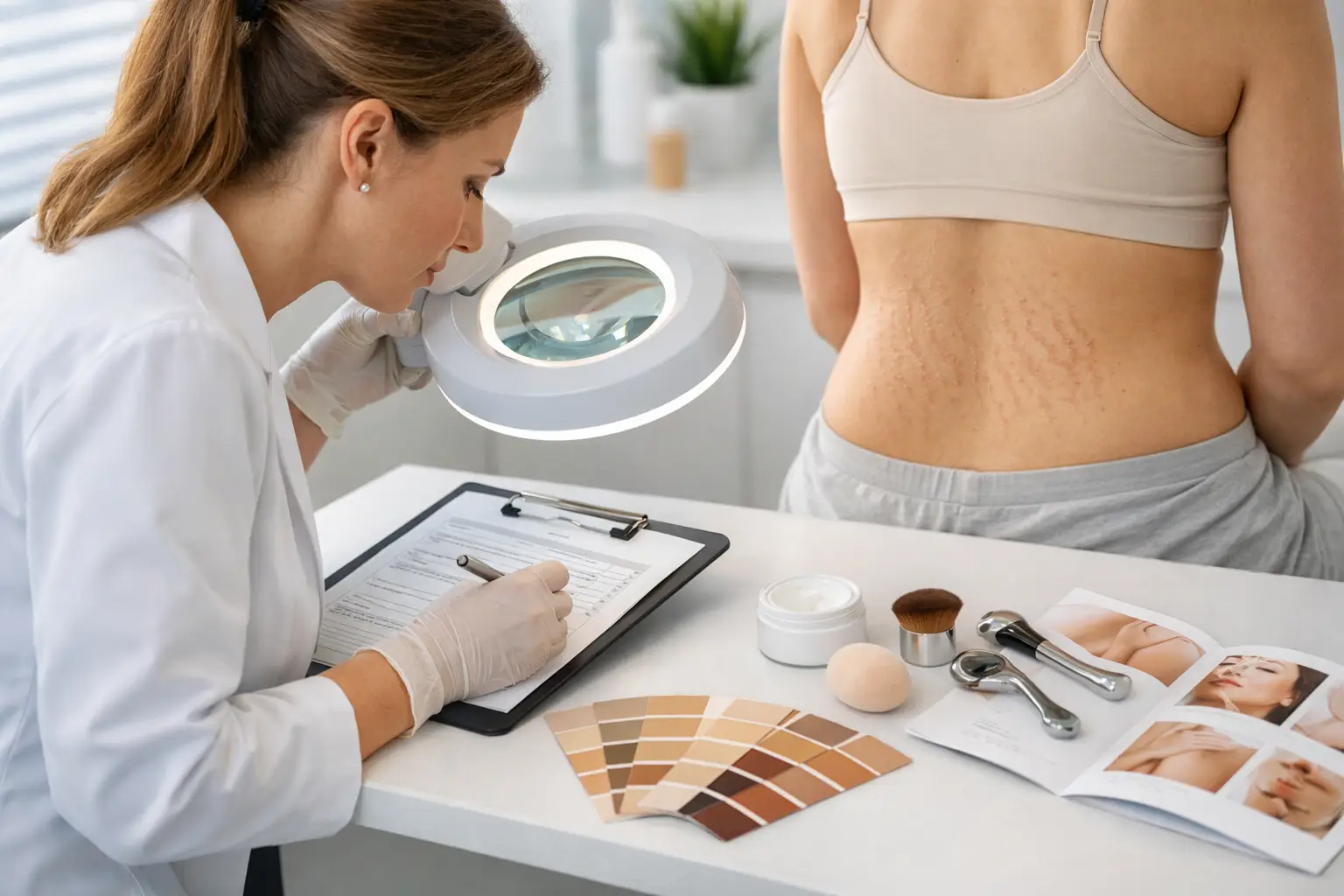
Stretch marks can look very different from one person to the next. Some are pale, flat and settled; others remain red, purple, raised, indented or reactive. That distinction matters when considering how to assess stretch mark suitability for camouflage tattooing or skin-restoration treatment. A strong result starts with an honest assessment of the skin, not a promise that every mark can be covered in the same way.
At Ink Illusions, suitability is approached as a specialist skin evaluation. The aim is to identify the treatment that gives the safest and most credible improvement, whether that is stretch mark camouflage tattooing, MCA inkless needling, radiofrequency microneedling, or a staged combination approach.
Why suitability comes before pigment selection
Stretch mark camouflage is not simply a matter of matching a pigment to the surrounding skin tone. The procedure places carefully selected colour into the skin to reduce the contrast between stable stretch marks and healthy skin. If the marks are still changing, inflamed or significantly textured, camouflage may not be the right first step.
Pigment can soften the appearance of colour difference, but it cannot reliably erase deep indentations, raised tissue or active inflammation. This is why an experienced practitioner assesses the whole area: the age and colour of the stretch marks, their texture, the client’s skin behaviour, the location on the body and the likelihood of future skin changes.
The objective is visible blending and restored confidence, not an unrealistic claim of flawless, poreless skin.
How to assess stretch mark suitability accurately
A consultation should go beyond photographs and a quick colour match. Photos can be helpful, particularly for clients travelling from elsewhere in the UK, but lighting can hide texture and alter the apparent skin tone. An in-person assessment remains the best way to evaluate the tissue and plan treatment responsibly.
Check whether the stretch marks are mature
Mature stretch marks are generally the strongest candidates for camouflage. They are usually white, silver or close to the client’s natural skin tone, and they have remained unchanged for a sustained period. The skin should feel settled rather than itchy, tender or inflamed.
Newer marks are often red, pink, purple or dark brown depending on the skin tone. These are commonly referred to as active stretch marks. They may still be responding to hormonal changes, rapid weight change, pregnancy, puberty, bodybuilding or medication. Camouflage tattooing at this stage is usually deferred because the marks and surrounding skin may continue to change.
A practitioner may recommend waiting until the marks have stabilised. Where appropriate, skin-repair treatments such as MCA inkless needling or radiofrequency microneedling may be considered first to support texture improvement, but suitability still depends on individual skin health and medical history.
Assess texture, not just colour
Stretch marks often have a textural component. They may be slightly sunken, crepey, wide or irregular. Camouflage pigment can reduce the visual contrast, but it does not physically lift an indentation. In fact, placing pigment into unstable or severely textured tissue without preparation can make expectations harder to meet.
During assessment, the practitioner should examine how light catches the marks and whether texture remains visible when the skin is gently stretched. A flat, stable mark with colour contrast may be an excellent camouflage candidate. A deeply indented area may benefit from a treatment plan focused first on collagen stimulation and skin quality.
This is one of the most valuable trade-offs to explain clearly. Camouflage can create a significant visual improvement, while skin-revision treatments may improve texture over time. Some clients need one approach; others achieve the most natural outcome from both, performed in the right order.
Consider skin tone and tanning habits
Advanced stretch mark camouflage requires more than choosing a beige pigment. Natural skin tone contains warmth, coolness, depth and subtle variation. It can also shift according to circulation, temperature, sun exposure and the healing response.
A specialist practitioner assesses the untreated skin surrounding the marks, rather than relying on a colour seen elsewhere on the body. A custom pigment blend may be needed, particularly for deeper skin tones or areas with uneven pigmentation. A patch test can be advisable where sensitivity, complex pigmentation or previous adverse reactions are a concern.
Tanning habits matter too. Camouflage pigment does not tan in the same way as natural skin. If a client frequently uses sunbeds, self-tan or intense sun exposure, the contrast between treated and untreated skin may change. This does not automatically rule treatment out, but it must be part of the decision-making process and aftercare plan.
Review the body area and likely future changes
Stretch marks on the abdomen, hips, buttocks, thighs, breasts, arms and lower back can all be assessed for treatment, but each area has different considerations. The abdomen may be affected by future pregnancy or weight fluctuations. The breasts may change with hormonal shifts, breastfeeding or surgery. Areas exposed to friction, exercise clothing or regular sun can require more careful aftercare.
A client does not need to have a completely static body to be suitable. However, they should understand that substantial future stretching can alter both the stretch marks and the camouflage result. For someone actively losing or gaining a significant amount of weight, waiting until their weight is more stable may produce a more predictable outcome.
Take medical history and skin health seriously
A professional suitability assessment includes a confidential health consultation. Certain conditions, medications and healing patterns can affect whether treatment is appropriate now, later or not at all.
Treatment may need to be postponed or declined where there is active eczema, psoriasis, dermatitis, infection, sunburn, open skin, uncontrolled diabetes, a tendency towards keloid scarring, or an impaired healing response. Recent surgery, steroid use, isotretinoin use, pregnancy and breastfeeding also require individual consideration. Clients with a history of allergies, autoimmune conditions or previous pigment reactions should disclose this before any procedure is booked.
This is not unnecessary caution. Camouflage tattooing and needling are specialist procedures that intentionally work with the skin’s healing process. The safest result depends on skin that can recover predictably.
When stretch mark camouflage may not be the first treatment
Not every concern should be treated with pigment first. Fresh red or purple marks, prominent inflammation, deep textural changes and unstable skin may call for a different starting point.
MCA inkless needling can be used within an appropriate treatment plan to stimulate the skin’s natural repair response without depositing camouflage pigment. Radiofrequency microneedling may also be considered for certain clients where texture, laxity or collagen support is the central concern. Neither treatment is a guaranteed erasure of stretch marks, and results develop gradually, but they can improve the quality of the tissue before camouflage is considered.
For some clients, the most responsible recommendation is to wait. That may feel disappointing in the short term, but it protects the long-term result. A specialist clinic should be prepared to say when treatment is not yet indicated.
Setting realistic expectations for camouflage results
The best candidates understand that stretch mark camouflage is an art and a technical procedure. It is designed to make marks less noticeable from normal social distance by reducing contrast and helping the area blend with the surrounding skin.
Multiple sessions may be required. Healed pigment can look different from freshly applied pigment, and a review appointment allows the practitioner to assess retention, colour adjustment and any areas that need further refinement. Healing also varies between individuals and body areas.
Clients should expect a period of aftercare, including protecting the treated area from friction, excessive sweating, swimming, sun exposure and products that may irritate healing skin. Following aftercare instructions is part of suitability. A technically excellent procedure can be compromised if the area is not allowed to heal properly.
Questions worth asking before booking
Before committing to any stretch mark treatment, ask what method is being recommended and why. Ask whether the marks are mature enough, how texture will affect the result, whether a patch test is appropriate and how many sessions may be needed. It is also sensible to ask to see healed work on skin tones and stretch mark patterns similar to your own.
For practitioners, the same discipline should guide every client consultation. A treatment system is only as credible as its assessment process. Good outcomes come from recognising contraindications, understanding pigment behaviour in compromised tissue and knowing when skin revision should come before camouflage.
The right treatment plan should leave you feeling informed rather than pressured. When stretch marks are stable, skin health is suitable and expectations are grounded in what the procedure can genuinely achieve, camouflage can offer a meaningful, confidence-restoring change.